Emergency Contraception: Plan B vs ella vs Copper IUD
Plan B, ella or a copper IUD can help prevent pregnancy after unprotected sex. Compare timing windows, body-weight concerns, prescription rules and what CDC guidance says.

On this page
- What is emergency contraception and when is it used?
- Which emergency contraception option should you choose?
- How long after sex can you still use emergency contraception?
- Plan B vs ella: how do they differ?
- Does body weight affect emergency contraception?
- How does the copper IUD work as emergency contraception?
- What should you do right after taking emergency contraception?
- Does emergency contraception have side effects?
- What the research says
- When to see a doctor
- Regional notes
- Frequently asked questions
- The bottom line
Emergency contraception is a backup for sex that was unprotected or for a method that may have failed. Timing decides how well it works. The levonorgestrel pill, sold as Plan B One-Step and generics, is labeled for use within 72 hours. Ulipristal acetate (ella) works up to 120 hours, and a copper IUD can be inserted within 5 days. Sooner is better for every option.
Emergency contraception (EC): a method used after unprotected sex or a failed birth control method to lower the chance of pregnancy. It is not a regular form of birth control.
Key takeaways
- The levonorgestrel pill (Plan B One-Step and generics) is sold over the counter in the United States with no age limit, and its labeling covers use within 72 hours (FDA product labeling).
- CDC guidance says emergency contraceptive pills should be taken as soon as possible within 5 days of unprotected sex, and the sooner they are taken, the better they work (CDC U.S. SPR 2024).
- Ulipristal acetate (ella) is a single 30 mg dose that needs a prescription in the United States, and hormonal contraception should not be started until 5 days after taking it (CDC U.S. SPR 2024).
- A copper IUD may be placed within 5 days of unprotected sex as emergency contraception, and CDC calls it highly effective. It can then stay in place as regular contraception (CDC U.S. SPR 2024).
- Up to 3 days after sex, ulipristal and levonorgestrel have similar effectiveness. Between 3 and 5 days, CDC notes that ulipristal was observed to be more effective (CDC U.S. SPR 2024).
- CDC says levonorgestrel "might be less effective than UPA among women with obesity," so body weight is a reason to talk with a clinician about options (CDC U.S. SPR 2024).
- CDC publishes no typical-use failure rate for emergency contraception, so its effectiveness is described by timing and comparisons rather than a single percentage (CDC Contraception and Birth Control Methods, Aug 6, 2024).
What is emergency contraception and when is it used?
Emergency contraception is a backup for sex that was not protected by birth control, or for a time when a method may have failed. CDC's contraception guidance says it "is not a regular method of birth control." It can be used when no birth control was used during sex, or when the birth control method failed. In practice that covers a condom that tore or slipped, a missed pill (see our guide to what to do after a missed birth control pill), a late patch or ring, or a diaphragm that moved out of place. It also covers sex with no method at all, including sex that was forced.
Illustrative example: a 27-year-old notices near the end of sex on a Friday night that the condom slipped. She is not sure what to do, and she worries about waiting too long. The clock started at that moment, so the useful step is to decide that same day, not the following week.
Most emergency pills work mainly by delaying or preventing ovulation, the release of an egg from the ovary. They do not end a pregnancy that has already begun. A copper IUD works differently, as described later in this article. Knowing this helps explain why timing matters so much: the earlier the dose, the better the chance that ovulation has not yet happened.
Which emergency contraception option should you choose?
Three options cover most situations people compare: the levonorgestrel pill, ulipristal acetate and the copper IUD. The table below uses the timing rules in the sources cited in this article. Where the product label and CDC guidance differ, both are shown.
| Option | Works up to | Prescription in the US? | Key point |
|---|---|---|---|
| Levonorgestrel pill (Plan B One-Step, generics) | 72 hours on the product label; CDC says within 5 days, sooner is better | No. Sold over the counter with no age limit | Works best early. CDC notes it may be less effective than ulipristal in women with obesity |
| Ulipristal acetate (ella) | 120 hours (5 days) | Yes | Delay starting hormonal contraception for 5 days after taking it |
| Copper IUD | Within 5 days of unprotected sex | Placed by a clinician, not a pill | Highly effective, according to CDC; can stay in place as regular contraception |
For a broader view of which method suits you long term, read how to choose the right birth control. Use this checklist to narrow the choice quickly:
- Count the time since the sex or the failed method. Write down the hour, if you can.
- If you are within 72 hours, the levonorgestrel pill and ulipristal are both possible. Ulipristal may be the better choice from day 3 onward.
- Check whether you can buy a pill without a prescription, or whether you need a clinician for ella or an IUD.
- Think about body weight. If you have obesity, ask a clinician or pharmacist which option they would choose first.
- Decide whether you want ongoing contraception. A copper IUD can be kept as a long-term method.

How long after sex can you still use emergency contraception?
Timing is the most important factor, and the sources describe it in slightly different ways. The product labeling for levonorgestrel pills covers use within 72 hours. CDC's U.S. Selected Practice Recommendations (SPR) 2024 say emergency contraceptive pills should be taken "as soon as possible within 5 days of unprotected sexual intercourse." The difference is partly about how each source treats the research: labeling sets a regulatory boundary, while CDC summarizes the evidence available across options.
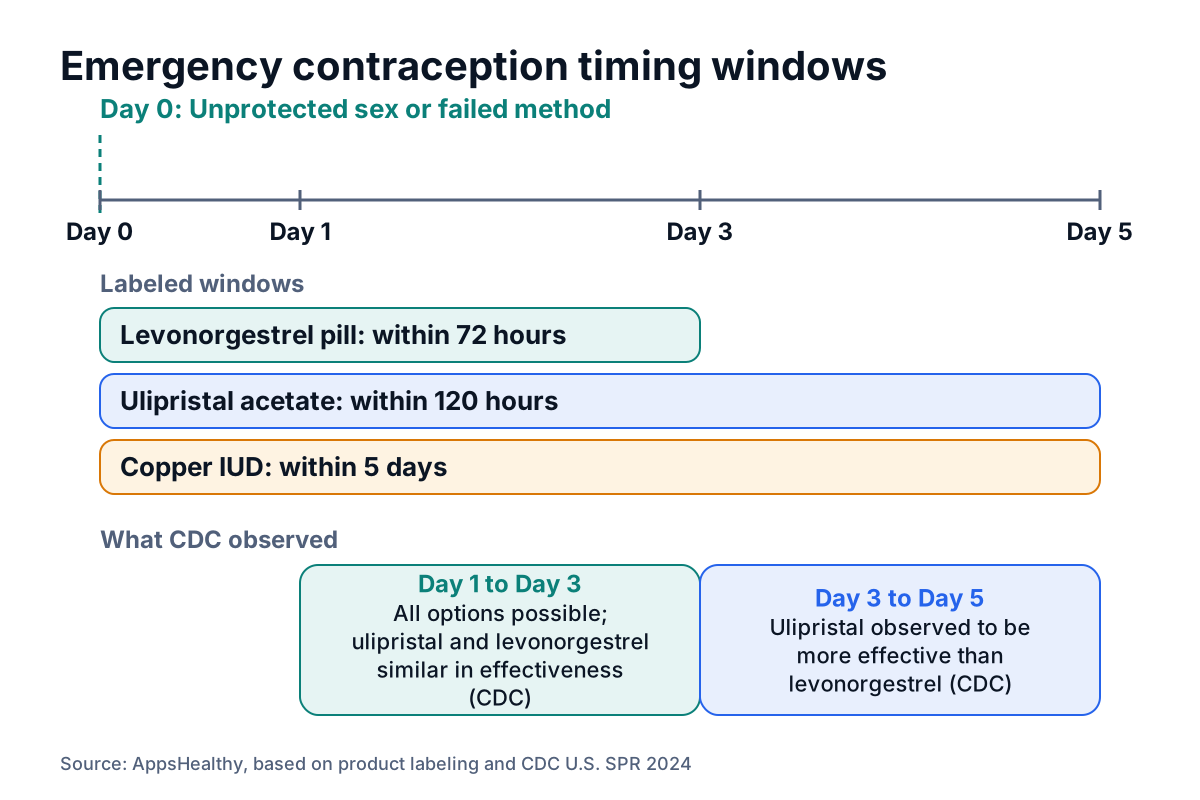
CDC's summary of the levonorgestrel research adds a useful detail. Pregnancy rates were low when the pill was taken within 4 days after unprotected sex, but they increased between 4 and 5 days. That is why CDC's advice is to take the pill as early as possible, even if the labeled window seems generous. The chart below shows the windows in hours, using only figures from the sources above.

Pay attention to the difference between a window and a success rate. A later window does not mean an option works equally well at every point within it. CDC's own comparison suggests that the pill's performance drops off as time passes, and that ulipristal holds up better from day 3 to day 5.
Plan B vs ella: how do they differ?
Plan B and ella both act as emergency pills, but they differ in timing, prescription rules and some practical details. Neither is a routine method, and both are used after the fact, so the question is usually which one fits your timing and access.
When is the levonorgestrel pill a practical first choice?
The levonorgestrel pill is the most accessible option in the United States. It is sold over the counter with no age limit (see over-the-counter birth control for how that compares with daily pills). That makes it the usual choice when you are within the first few days and can get to a pharmacy quickly. CDC describes it as similarly effective to ulipristal when taken within 3 days of unprotected sex, so an early dose gives you a strong option without a visit to a clinic.
When does ella make more sense?
Ulipristal acetate covers a longer window, up to 120 hours, and CDC notes it was observed to be more effective than levonorgestrel between 3 and 5 days after sex. If you are past day 3, or if you have concerns about body weight, ella may be the better option to discuss with a clinician. The trade-off is the prescription requirement and a waiting period before hormonal contraception can start.
Why does ella need a prescription in the US?
CDC's contraception page says some emergency pills are sold over the counter while others need a prescription in the United States. Ulipristal acetate is in the prescription group, which is why many people contact a clinician, telehealth service or pharmacist who can arrange access. The U.S. Food and Drug Administration (FDA) sets these rules through product labeling, so check the current label and ask your prescriber for the latest details.
Does body weight affect emergency contraception?
Body weight is one of the most searched questions about the morning-after pill, and the research is more nuanced than many headlines suggest. The honest summary is that some options may be less effective in some people, and that a clinician can help you choose early rather than guess.
What does the CDC say about obesity?
CDC's U.S. SPR 2024 says the levonorgestrel pill "might be less effective than UPA among women with obesity." The statement compares the levonorgestrel pill with ulipristal, and it uses the word "might" because the evidence is limited. The same page includes no separate recommendation for emergency contraception in people with obesity.
Is there a weight cutoff for Plan B?
Many readers search for a "Plan B weight limit." The CDC summary quoted above does not describe a body-weight cutoff. In 2016 the FDA said the data on weight were conflicting and too limited to support a labeling change, and a 2014 European Medicines Agency (EMA) review concluded that emergency pills can be used regardless of body weight. The UK's FSRH takes a more cautious line: for people who weigh more than 70 kg or have a BMI above 26, it suggests ulipristal or a double dose of levonorgestrel, with the copper IUD as the most effective choice. If weight is a concern, talk with a clinician or pharmacist about whether ulipristal or a copper IUD makes more sense. Do not skip the decision because you are unsure about a number you heard online.
How does the copper IUD work as emergency contraception?
A copper intrauterine device (IUD) is a small T-shaped device placed inside the uterus by a clinician. Copper changes the environment in the uterus so that sperm and an egg are less likely to meet or a fertilized egg is less likely to implant. CDC describes the copper IUD as highly effective for emergency contraception, and it is the only IUD on CDC's list of emergency options.
How soon must it be placed?
CDC says the copper IUD "may be placed within 5 days of the first act of unprotected sexual intercourse as emergency contraception." CDC also states that it can be placed more than 5 days after sex, as long as placement does not occur more than 5 days after ovulation. Because the timing depends on when ovulation happened, a clinician usually makes that call. Do not wait for that appointment if you are close to the 5-day limit; call a clinic as soon as you can.
Why choose it if you want long-term protection?
A copper IUD can keep working as ongoing birth control after it is placed for emergency use, which the other emergency options cannot do. For someone who already knows they want a long-acting method, it can be a practical choice. Your clinician can talk through insertion, follow-up and whether a hormonal IUD might suit you better. A related comparison appears in our guide to hormonal vs copper IUDs.

Try it
Before your next visit, use the Cerca helper to see which emergency options still fit your timing, then take that list to a pharmacist or clinician.
What should you do right after taking emergency contraception?
Taking the dose is the first step. The steps below help you manage the days that follow and plan ongoing protection.
- Write down the date and time you took the pill, and keep the packaging or receipt for your records.
- If you vomit within 3 hours of taking a pill, CDC advises taking another dose as soon as possible. Ask a pharmacist or clinician to help you get one.
- Plan your next step for regular contraception. Ask when to restart hormonal birth control, because the timing rules differ between ulipristal and levonorgestrel.
- If you took ulipristal, CDC says any nonhormonal method may start immediately, and hormonal methods should wait at least 5 days. After you start or restart a hormonal method, use condoms or avoid sex for the next 7 days or until your next period, whichever comes first. After levonorgestrel, any regular method can start right away, with condoms or no sex for 7 days.
- Track your next period. A period that comes early, late or heavier than usual is common after emergency contraception and does not always mean pregnancy, but a late period is a reason to test.
Several readers also ask whether emergency contraception changes their long-term plans. It does not. Your regular method can stay the same, or you can choose a new one, as long as you pick it with your clinician.
Tracking your cycle can help you notice a late or unusual period and bring a clear record to your appointment. A helper that ranks your options by time remaining is useful in the first hours. The cycle tracking features in Cerca show your next period prediction, but they are not contraception, so use a method that works for you while you wait.
Does emergency contraception have side effects?
Emergency pills are generally well tolerated. The side effects most often described in patient information are nausea, headache, tiredness, breast tenderness and a change in the timing or flow of your next period. These are usually short-lived. The NHS contraception guide and your pharmacist can help you check the details for the product you choose.
A copper IUD works differently. It can make periods heavier or more painful, particularly in the first few months, and insertion can be uncomfortable. Ask your clinician about pain relief before the appointment if you are worried about it.
Emergency contraception does not protect against sexually transmitted infections. If you may have been exposed to one, ask a clinician about testing, and consider condoms with any new partner until you have been checked.
What the research says
The strongest guidance on emergency contraception comes from the CDC's U.S. Selected Practice Recommendations 2024, which summarizes the evidence behind each option. On its emergency contraception page, CDC grades the levonorgestrel evidence as level I to II-2, which it describes as ranging from good to poor. The strongest findings concern timing: pregnancy rates rise as the delay grows, and the advantage of ulipristal appears between day 3 and day 5.
Two studies of ulipristal are cited by CDC. They found consistent decreases in pregnancy rates when the drug was given within 120 hours of unprotected sex. CDC uses these studies to support the 5-day window and its statement that ulipristal may be more effective than levonorgestrel after the third day. The evidence is solid for the window itself but is less detailed for specific subgroups.
The statement that levonorgestrel "might be less effective than UPA among women with obesity" is a signal from comparative evidence. It is best read as a reason to discuss options with a clinician, not as a settled rule. CDC uses the word "might" for this reason. The copper IUD is described by CDC as highly effective for emergency use, and it is the only IUD on CDC's emergency list.
The WHO Family Planning Handbook is a practical reference for clinicians working on emergency contraception and other methods worldwide. For global context on family planning, the WHO family planning fact sheet is a good starting point.
When to see a doctor
Most people who take emergency contraception feel fine afterward. A small number of symptoms need prompt medical attention, and a pharmacist or clinician can help you decide what to do.
Get urgent care if you notice
- Severe pain in your lower abdomen, especially on one side, or pain at the tip of your shoulder, dizziness or fainting. These can be signs of an ectopic pregnancy, which needs urgent care.
- Bleeding heavier than a period, or bleeding with severe pain.
- A late period together with a positive pregnancy test and any of the symptoms above.
- Vomiting soon after a dose when you are unsure whether to take another. Call a pharmacist or clinician right away rather than waiting.
If sex was forced, a sexual assault support service or sexual health clinic can offer emergency contraception, testing and support. You do not need to explain every detail to get help, and you can ask for a clinician of a particular gender if that matters to you.
Regional notes
United States (FDA, CDC, ACOG). The U.S. Food and Drug Administration (FDA) sets the product labeling for emergency pills. The levonorgestrel pill is sold over the counter with no age limit, while ulipristal acetate (ella) requires a prescription. The CDC's U.S. SPR 2024 gives the clinical guidance used across the country, and the CDC contraception hub collects patient information, and the American College of Obstetricians and Gynecologists (ACOG) publishes patient FAQs on birth control. Stock varies by pharmacy, so call ahead if you need a specific option. Planned Parenthood also explains options and clinic access in plain language.
United Kingdom (NHS, FSRH). Both emergency pills, levonorgestrel and ulipristal acetate, are available from pharmacies without a prescription, as well as from sexual health services and GPs, and the NHS contraception guide explains the options in plain language. The Faculty of Sexual and Reproductive Healthcare (FSRH) publishes the clinical guidance that UK clinicians follow, including the rules for placing a copper IUD as emergency contraception. Your local sexual health service can arrange a quick appointment if you need one.
European Union and Australia. Rules about prescriptions, age limits and product names differ by country. Some emergency pills are available without a prescription in some countries and need one in others. Check your national regulator and the public health service in your country, and ask a pharmacist which product they stock, since brand names change between markets.
South Asia and the Middle East. Availability and legal status vary widely across this region, and some countries restrict access for young people or require a prescription. Your national health ministry, a public clinic or a licensed pharmacist is the best place to check. The WHO family planning fact sheet gives global context if you want to read further.
Frequently asked questions
How soon after sex should I take Plan B?
As soon as you can. The levonorgestrel pill is labeled for use within 72 hours, and CDC's U.S. SPR 2024 advises taking emergency pills as soon as possible within 5 days of unprotected sex, with the sooner the better. Plan B works best when taken early, so buy it at a pharmacy without a prescription if you are within the first few days, and ask a clinician about other options if you are unsure.
How late can I take Plan B?
The product labeling covers use within 72 hours. CDC's guidance extends the timing to 5 days for emergency pills, and it notes that ulipristal acetate (ella) was observed to be more effective than levonorgestrel between 3 and 5 days. Ella needs a prescription in the United States. A copper IUD placed within 5 days is another option, so call a clinic promptly if you are past day 3.
Does Plan B work if I weigh more?
CDC says the levonorgestrel pill "might be less effective than UPA among women with obesity." The statement does not set a weight cutoff that rules out the pill. If body weight is a concern, ask a pharmacist or clinician whether ulipristal acetate or a copper IUD suits you better. Do not delay while you research, since the window for each option is limited.
Is ella better than Plan B?
Not always. CDC notes that the two are similarly effective when taken within 3 days after sex, while ulipristal was observed to be more effective between 3 and 5 days. Ella needs a prescription in the US, and hormonal birth control should wait 5 days after taking it. The right choice depends on timing, access and body weight, so compare both with a clinician rather than choosing by brand name alone.
Can I get a copper IUD as emergency contraception?
Yes, if a clinician can place it within 5 days of unprotected sex. CDC says the copper IUD may be placed within 5 days as emergency contraception and calls it highly effective. It can continue as regular contraception afterward. Placement is done by a trained clinician, so call early, because a delay can take you past the window. You can read more in our guide to hormonal and copper IUDs.
Does emergency contraception end a pregnancy?
No. Emergency pills are not designed to end a pregnancy that has already started, and they work mainly by delaying or preventing ovulation. If you think you might already be pregnant, take a pregnancy test and talk with a clinician about your options. Emergency contraception lowers the chance of pregnancy after sex but does not replace a test or medical care.
Do I need a pregnancy test after emergency contraception?
If your next period is late, or you notice early pregnancy signs, take a home pregnancy test and speak with a clinician. Emergency contraception lowers the chance of pregnancy but does not remove it entirely, so a late period is a reason to test. Seek urgent care if a positive test comes with sharp, one-sided abdominal pain or dizziness.
Can I use emergency contraception as my regular birth control?
No. CDC describes emergency contraception as not a regular method of birth control. If you have unprotected sex often, a regular method such as the copper IUD, the implant or a daily pill is more reliable. Cerca has a methods library with CDC 2024 typical-use effectiveness for each option, and Bedsider is a plain-language next step.
The bottom line
Emergency contraception can lower the chance of pregnancy after unprotected sex, and it works best when you act early. The levonorgestrel pill is labeled for use within 72 hours and is sold over the counter in the United States. Ulipristal acetate (ella) covers up to 120 hours but needs a prescription in the US. A copper IUD placed within 5 days is highly effective and can continue as long-term birth control. CDC says levonorgestrel may be less effective than ulipristal in women with obesity, so body weight is a good reason to talk with a clinician. Keep the timing in mind, check your options early, and use a regular method if sex is frequent and pregnancy is not wanted. Cerca is free to use, private, and needs no email to start. Its emergency contraception helper ranks your options by the time remaining.
Medical disclaimer
This article is for education only and is not medical advice. It does not replace a visit to a pharmacist, clinician or sexual health service. Talk with a clinician before choosing or changing any contraceptive method, and seek urgent care for any warning sign listed above.
References
- Centers for Disease Control and Prevention (CDC). "Contraception and Birth Control Methods." Dated August 6, 2024. https://www.cdc.gov/contraception/about/index.html
- Centers for Disease Control and Prevention (CDC). "U.S. Selected Practice Recommendations for Contraceptive Use, 2024: Emergency Contraception." 2024. https://www.cdc.gov/contraception/hcp/usspr/emergency-contraception.html
- Centers for Disease Control and Prevention (CDC). "U.S. Selected Practice Recommendations for Contraceptive Use, 2024." 2024. https://www.cdc.gov/contraception/hcp/usspr/index.html
- U.S. Food and Drug Administration (FDA). Product labeling for levonorgestrel emergency contraceptives (Plan B One-Step and generic equivalents). Search the FDA website for the product name. https://www.fda.gov/ [VERIFY LINK]
- U.S. Food and Drug Administration (FDA). Product labeling for ulipristal acetate (ella). Search the FDA website for the product name. https://www.fda.gov/ [VERIFY LINK]
- Faculty of Sexual and Reproductive Healthcare (FSRH). "FSRH Clinical Guideline: Emergency Contraception." March 2017 (amended). https://www.fsrh.org/
- National Health Service (NHS). "Contraception." https://www.nhs.uk/contraception/
- American College of Obstetricians and Gynecologists (ACOG). "Patient FAQs: Birth Control." https://www.acog.org/womens-health/faqs
- World Health Organization (WHO). "Family planning/contraception" fact sheet. https://www.who.int/news-room/fact-sheets/detail/family-planning-contraception
- World Health Organization (WHO). "Family Planning: A Handbook for Providers." https://fphandbook.org/
- Centers for Disease Control and Prevention (CDC). "Contraception." https://www.cdc.gov/contraception/
- Planned Parenthood. "Birth control." https://www.plannedparenthood.org/learn/birth-control
- Bedsider. "Birth control methods." https://www.bedsider.org/
- U.S. Food and Drug Administration (FDA). Statement on levonorgestrel emergency contraception and body weight. May 2016. [VERIFY LINK]
- European Medicines Agency (EMA). "Emergency contraceptives: referral" (review of levonorgestrel and ulipristal acetate and body weight, concluded July 2014). https://www.ema.europa.eu/en/medicines/human/referrals/emergency-contraceptives
Cerca
Plan contraception with WHO and CDC-checked guidance: compare 12 methods and build a 5-year plan. Free to use, no email needed.


