Is HRT Safe Now? What the FDA's 2025 Warning Change Means
The FDA has begun removing class-wide boxed warnings from menopause hormone therapy. Here is what the research says about HRT risks, benefits and timing, and how to decide.

On this page
- Is HRT safe for most women?
- What did the FDA change in 2025?
- What is HRT, and who takes it?
- What the research says
- Does HRT raise breast cancer risk?
- Does HRT affect the heart, stroke and blood clots?
- Does the timing of HRT matter?
- Does HRT protect bones and ease symptoms?
- How can you weigh HRT for yourself?
- Are there alternatives to HRT?
- When to see a doctor
- Regional notes
- Frequently asked questions
- The bottom line
Is HRT safe? For many healthy women who start it near menopause, hormone replacement therapy (HRT) is a safe and effective treatment for hot flashes, vaginal dryness and sleep disruption. Safety depends on your age, the years since your last period, whether you still have a uterus, and your health history. In November 2025 the U.S. Food and Drug Administration (FDA) began removing class-wide boxed warnings from menopausal hormone therapy labels.
HRT (hormone replacement therapy): prescription estrogen, usually paired with a progestogen if you still have a uterus, used to replace hormones that the ovaries stop producing around menopause.
Key takeaways
- On November 10, 2025, the FDA announced it would remove references to cardiovascular disease, breast cancer and probable dementia from the boxed warning on menopausal hormone therapy labels, according to the FDA's own press release.
- The boxed warning about endometrial (uterine lining) cancer stays on estrogen-alone products, because estrogen without a progestogen can thicken the uterine lining.
- The 2002 Women's Health Initiative (WHI) estrogen-plus-progestin trial reported more heart events, strokes, blood clots and invasive breast cancers than placebo, in an average participant aged 63.
- The Menopause Society's 2022 position statement says benefits generally outweigh risks for healthy women with bothersome symptoms who start hormone therapy under age 60 or within 10 years of menopause onset.
- The Menopause Society says vaginal estrogen, which acts mainly on vaginal tissue, can be used at any age for genitourinary symptoms.
- Transdermal estradiol (patch or gel) appears to carry a lower blood clot risk than oral estrogen, based mainly on observational studies.
- The absolute risk of serious harm is small for most women in their 50s, but it rises with age, years since menopause and duration of use.
Is HRT safe for most women?
The honest answer is that HRT is safer for some women than others, and the right choice depends on when you start, which hormones you take and why. Much of the public debate traces back to one large trial that enrolled mostly women well past menopause, and headlines in either direction tend to flatten that nuance.
Illustrative example: a 52-year-old woman who stopped having periods 18 months ago wakes three or four times a night, drenched in sweat, and her concentration at work is slipping. Her personal risk of breast cancer, heart disease or stroke depends on her family history, blood pressure, cholesterol and smoking status, not on her age alone.
Current guidance reflects this individual approach. The Menopause Society, the leading North American menopause organization, published a 2022 position statement on hormone therapy. It describes the benefit-risk balance as most favorable for healthy women with bothersome symptoms who begin treatment close to menopause. The balance becomes less favorable for women who start more than 10 years after menopause or after age 60, mainly because absolute risks of coronary heart disease, stroke, blood clots and dementia rise with age. The statement is published on The Menopause Society's website.
In the United Kingdom, the National Institute for Health and Care Excellence (NICE) guideline NG23 treats HRT as an effective option for bothersome symptoms and asks clinicians to discuss benefits and risks before a woman decides. You can read it on the NICE website. Both documents share one message: HRT is a medical treatment with real benefits and real risks, and the decision should be individual, reviewed over time and made with a clinician.
A tracker like Shebalance can help you prepare for that conversation. It lets you log hot flashes, night sweats and sleep in one tap and turns the pattern into a doctor-ready PDF.
What did the FDA change in 2025?
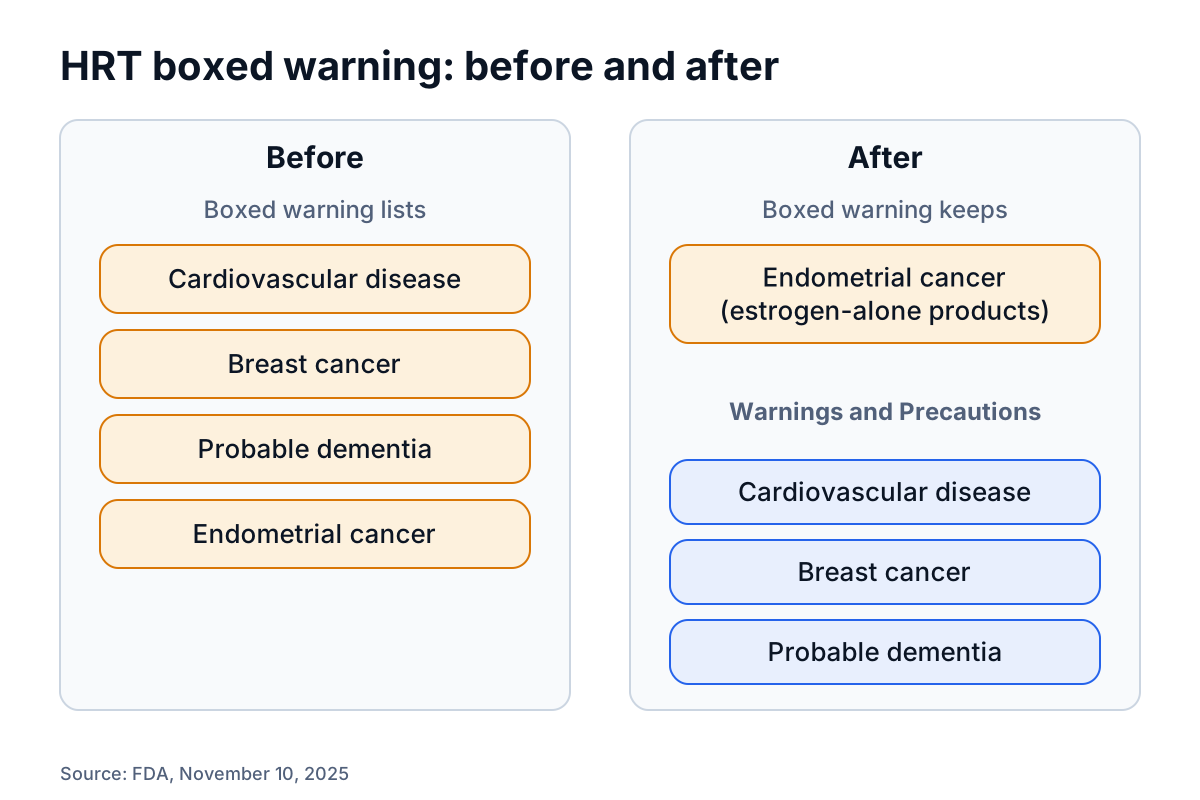
On November 10, 2025, the FDA announced that it was starting to remove the "black box" warnings from menopausal hormone therapy products. In its press release on the labeling changes, the agency said it was "working with companies to update language in product labeling to remove references to risks of cardiovascular disease, breast cancer, and probable dementia."
A boxed warning is the strongest warning the FDA requires on a prescription label. For menopausal hormone therapy, these warnings were applied in the early 2000s after the WHI results were published. The FDA itself notes that the WHI breast cancer finding was "a statistically non-significant increase in the risk of breast cancer diagnosis," that the average trial participant was 63, well past the typical age of menopause, and that the hormone formulation tested is no longer in common use. Those details are central to why the agency now treats the blanket warning differently.
Which warnings were removed?
The references removed from the boxed warning are cardiovascular disease, breast cancer and probable dementia. The FDA's consumer update on hormone replacement therapies explains that these risks are not erased. They remain described in the Warnings and Precautions section of the label, which the FDA did not ask companies to remove.
What the FDA kept
The boxed warning for endometrial cancer stays on systemic estrogen-alone products. Estrogen that is not balanced by a progestogen can stimulate the uterine lining, which raises the risk of endometrial cancer. This is why clinicians prescribe a progestogen with estrogen for women who still have a uterus. On February 12, 2026, the FDA approved the first label changes, covering six products across all four hormone therapy categories, and it asked 29 drug companies to submit updated labels, so older packaging may still be in circulation.
What is HRT, and who takes it?
HRT replaces the estrogen that falls during the menopausal transition and, for many people with a uterus, a progestogen as well. Common estrogens include estradiol and conjugated estrogens. Progestogens include micronized progesterone and synthetic forms such as medroxyprogesterone. The World Health Organization's menopause fact sheet gives a global overview of symptoms and treatment options.
Estrogen-alone therapy is used after a hysterectomy, because there is no uterine lining to protect. Combined therapy is used for women who still have a uterus. The route also matters. Pills pass through the liver before entering the bloodstream, while patches and gels deliver hormones through the skin. Vaginal creams, tablets and rings act mainly on the vaginal tissue.
The table compares the main categories. It is an overview, not a prescribing guide.
| Option | Who it usually suits | Common routes | What it treats best | Key safety point |
|---|---|---|---|---|
| Estrogen alone | Women without a uterus | Tablet, patch, gel, spray | Hot flashes, night sweats, bone protection | Boxed warning for endometrial cancer is retained |
| Estrogen plus progestogen | Women with a uterus | Tablet, patch, combined patch | Hot flashes and bone protection; the progestogen protects the uterine lining | Breast cancer and clot risks are associated with combined use and rise with duration |
| Low-dose vaginal estrogen | Anyone with genitourinary symptoms | Cream, tablet, ring | Vaginal dryness, painful sex, urinary symptoms | Much lower body-wide exposure than systemic therapy; can be used at any age |
What the research says
The most influential study is the Women's Health Initiative (WHI), a set of large randomized trials funded by the U.S. National Institutes of Health. Its estrogen-plus-progestin arm, published in the Journal of the American Medical Association (JAMA) in 2002, was stopped early after a mean of 5.2 years of follow-up because overall health risks appeared to exceed benefits. Compared with placebo, the combined-therapy group had more coronary heart disease events, strokes, pulmonary embolisms (blood clots in the lungs) and invasive breast cancers, and fewer hip fractures and colorectal cancers. Learn more on the Women's Health Initiative website.
The absolute numbers matter. As reported in published summaries, the combined group had about 7 extra coronary heart disease events, 8 extra strokes, 8 extra pulmonary embolisms and 8 extra invasive breast cancers per 10,000 women-years. There were about 6 fewer colorectal cancers and 5 fewer hip fractures per 10,000 women-years. The breast cancer confidence interval only just reached 1.00, which is why the FDA called that finding non-significant.

The WHI estrogen-alone arm, stopped in 2004, did not show the breast cancer increase seen in the combined group, although it showed a higher stroke risk and no reduction in heart disease. Later reanalyses of WHI data, including a 2013 JAMA report on long-term mortality, looked at outcomes by age at starting therapy. Researchers continue to debate how far the original findings apply to younger women and to modern products.
Because the average WHI participant was 63, many clinicians now read the trial as a warning about starting HRT late, not a verdict on all HRT. The Menopause Society's 2022 statement reflects this reading. It places the most favorable balance under age 60 or within 10 years of menopause, and ties longer use to a documented need, such as persistent hot flashes, with periodic reassessment.
The evidence is strong for the broad picture, that combined therapy carries risks that rise with time. It is more limited for precise numbers in specific age groups and for newer formulations. Observational studies can be shaped by who chooses HRT, and randomized trials of younger starters are fewer.
Does HRT raise breast cancer risk?
Breast cancer is the risk that most often shapes HRT decisions. The Collaborative Group on Hormonal Factors in Breast Cancer pooled data from many studies, and its analysis was published in The Lancet in 2019. It found that the breast cancer risk linked to combined estrogen-plus-progestogen therapy rose with years of use and returned toward baseline after stopping. Estrogen-alone therapy was linked to a smaller increase.
What the absolute risk looks like
Relative risk figures sound alarming, but absolute risk is what affects your decision. For most women the added breast cancer risk from HRT in the first few years is small, and it builds gradually. Ask your clinician to express the estimate as cases per 1,000 women over a stated period, and to compare it with your other risk factors.
What to do about screening
Keep up with breast screening on the schedule your clinician recommends. Report any new lump, skin change or nipple discharge promptly, whether or not you take hormones. A symptom diary also helps, because changes are documented rather than forgotten.
Does HRT affect the heart, stroke and blood clots?
In the WHI combined arm, coronary heart disease, stroke and pulmonary embolism were all higher than with placebo, with the largest relative increase for pulmonary embolism. Those participants were older and more likely to have heart risk factors, which is one reason younger, healthier starters may have a different profile. Small early-start trials, such as the Kronos Early Estrogen Prevention Study (KEEPS), reported no harm to carotid artery thickness in women who began close to menopause. These trials are small and short, so they cannot prove prevention, but they support the idea that the heart picture depends on age and time since menopause.
Why the route matters for clots
Observational studies suggest that oral estrogen carries a higher risk of venous thromboembolism (a clot in a leg vein or the lungs) than transdermal estradiol. Clinicians often consider a patch or gel for women with higher clot risk, weighing factors such as migraine with aura, smoking and clotting disorders. Do not change your prescription on your own. Bring the question to your clinician.
Does the timing of HRT matter?
Timing is the factor many experts now consider most important for HRT safety and benefit. The "timing hypothesis," sometimes called the "window of opportunity," proposes that starting hormones near menopause, while blood vessels are still relatively healthy, produces a different balance than starting many years later. The Menopause Society's thresholds reflect this idea, but the evidence is mostly observational and short-term, so treat it as a guide rather than a guarantee.
Timing matters for women who go through menopause early, including those with primary ovarian insufficiency. Their estrogen deficiency starts earlier and lasts longer. The Menopause Society notes higher risks of bone loss, heart disease and cognitive or mood changes in this group, which is why clinicians often discuss therapy more actively there. See our guide to early menopause and primary ovarian insufficiency.
Tracking symptoms is the practical way to bring timing into the conversation. Note when hot flashes started, how often they happen, and how they affect sleep and work. Our symptom tracking guide explains how to set this up.
Try it
Log hot flashes, night sweats and sleep for two to four weeks so your next HRT conversation starts with real patterns. Open Shebalance
Does HRT protect bones and ease symptoms?
HRT is most effective for vasomotor symptoms, the medical term for hot flashes and night sweats. The FDA's consumer update says hormone therapy can help relieve hot flashes, night sweats and vaginal dryness, and that it may reduce the risk of osteoporosis. The National Institute on Aging's menopause page explains that menopause usually happens in the mid-40s to mid-50s, so most women who consider HRT are in that window.
Bone loss speeds up in the years after menopause, and in the WHI combined arm hip fractures were fewer than with placebo. The Bone Health and Osteoporosis Foundation publishes resources on fracture prevention and treatment options, and our article on menopause and osteoporosis covers the wider picture.
Brain health is more complicated. In the Women's Health Initiative Memory Study, which enrolled women aged 65 and older, hormone therapy was associated with a higher rate of probable dementia than placebo. The 2025 label change moved the dementia reference out of the box, but the risk remains described in the label, and the age difference is part of why this finding is read differently for women in their 50s.
Genitourinary symptoms are a separate case. Vaginal dryness, painful sex and urinary symptoms often respond to low-dose vaginal estrogen. For details, see our guide to vaginal dryness and genitourinary syndrome of menopause.
How can you weigh HRT for yourself?
Shared decision-making is the standard approach in both the United States and the United Kingdom. Your clinician should explain the options, the expected benefits, the risks in absolute terms and the review plan. Use these steps to prepare.
- Write down your age and the years since your last period. The timing thresholds in current guidance depend on both.
- Confirm whether you still have a uterus. This decides whether you need a progestogen with estrogen.
- List your personal history. Include breast cancer, blood clots, stroke, heart disease, liver disease, migraine with aura and unexplained bleeding.
- List your family history. Note breast, ovarian, uterine or colon cancer, and early heart disease or clots.
- Track symptoms for two to four weeks. Record severity, timing and the effect on sleep and daily life. A Shebalance log can hold this record in one place.
- Ask about routes. Compare pills, patches, gels and vaginal products, and ask how each affects your clot risk.
- Ask for absolute numbers and a review date. Request benefits and risks as cases per 1,000 women over a stated period, and agree when you will reassess.
Bring your medicine and supplement list, your symptom record and your questions. Ask which product, route and dose your clinician recommends, why, and what would make them change course. Dosing belongs to your clinician, and the common principle across guidelines is the lowest effective dose for the shortest time that meets your needs.
Are there alternatives to HRT?
Yes. Some low-dose antidepressants, including certain SSRIs and SNRIs, reduce hot flashes for many women, and one low-dose paroxetine product has specific approval for that use in the United States. Gabapentin is another option clinicians sometimes use for night sweats. Newer non-hormonal medicines that act on the brain's temperature-control pathway have expanded the choice: the FDA approved fezolinetant (Veozah) in 2023 and elinzanetant (Lynkuet) in October 2025. Cognitive behavioral therapy has research support for how bothersome hot flashes feel. Each option has its own side effects and evidence base. Read our overview of non-hormonal hot flash treatments for a side-by-side view.
When to see a doctor
Get urgent care if you notice
- Vaginal bleeding after menopause, or any bleeding that changes from your usual pattern while on hormones.
- Sudden shortness of breath, chest pain, or coughing up blood, which can signal a clot in the lungs.
- Pain, swelling, warmth or redness in one leg, especially the calf, which can signal a clot in a deep vein.
- Signs of stroke, such as face drooping, arm weakness, trouble speaking or sudden vision loss.
- A severe headache unlike your usual headaches, or sudden numbness or confusion.
- A new breast lump, skin dimpling or nipple discharge.
- Severe pelvic or abdominal pain, or thoughts of harming yourself. In the U.S., call or text 988 in a crisis.
Book a routine appointment if symptoms are not improving after a few months, if side effects bother you, or if you have questions about continuing treatment.
Regional notes
United States. The FDA regulates hormone therapy labels, and its November 2025 announcement is the current reference point for the label change. The Office on Women's Health and the American College of Obstetricians and Gynecologists (ACOG) publish patient FAQs on menopause treatment.
United Kingdom. The National Health Service (NHS) explains menopause and treatment options for patients, and NICE guideline NG23 sets the clinical standard for menopause care in England and Wales. Perimenopausal women who still need contraception should also check Faculty of Sexual and Reproductive Healthcare (FSRH) guidance, because some hormonal methods are used differently around menopause.
European Union and Australia. Hormone therapy is regulated by national agencies, such as the European Medicines Agency and Australia's Therapeutic Goods Administration, and product labels can differ from the U.S. label. Ask your prescriber which label applies to the product you are given.
South Asia and the Middle East. HRT product range, formulations and prescription costs vary widely. Some products sold in the United States or United Kingdom may not be marketed locally. Check with your national health authority and a qualified gynecologist, and be cautious about unlicensed hormone products sold online.
Frequently asked questions
Is HRT safe for women in their 50s?
For many healthy women in their 50s who start HRT within about 10 years of their last period, the Menopause Society's 2022 position statement says benefits generally outweigh risks for bothersome symptoms. Risk still varies by personal history, family history, route and duration. Ask your clinician to estimate your personal absolute risk and set a plan for regular review.
Did the FDA say HRT is safe now?
No. The FDA removed references to cardiovascular disease, breast cancer and probable dementia from the boxed warning, but kept the endometrial cancer warning for estrogen-alone products, and it says the other risks remain in the Warnings and Precautions section. The change reflects a reassessment of the evidence, not a claim that HRT carries no risk.
What is the boxed warning about endometrial cancer?
The warning on estrogen-alone products reflects the fact that unopposed estrogen can increase the risk of endometrial (uterine lining) cancer. Women who still have a uterus are usually prescribed a progestogen with estrogen to protect the lining. Report any unexpected vaginal bleeding to your clinician promptly, because it needs evaluation even if you take a progestogen.
Does HRT cause breast cancer?
Combined estrogen-plus-progestogen therapy is associated with a small increase in breast cancer risk that tends to grow with years of use. Estrogen-alone therapy is associated with a smaller increase in large analyses. Absolute risk depends on your baseline risk and other factors, so ask your clinician for an estimate and keep up with recommended screening.
Are patches safer than pills for blood clots?
Observational studies suggest that transdermal estradiol, given by patch or gel, is associated with a lower risk of venous blood clots than oral estrogen. This is an observed association, not proof of benefit in every person. Your clinician can weigh the route against your clot risk, migraine history and other factors.
Can I start HRT after age 60?
Some women do start HRT after 60, but current guidance says the benefit-risk balance becomes less favorable for women who begin more than 10 years after menopause or after age 60. Clinicians may still consider continuing therapy for persistent symptoms or bone protection after careful evaluation. Vaginal estrogen for urinary and vaginal symptoms can be considered at any age.
What if I stop HRT and my symptoms return?
Hot flashes often return after stopping HRT, and that is common. Stopping can be done gradually, and your clinician may suggest a taper or a different option. Do not stop or switch medicines on your own. Discuss timing with your prescriber so that both your symptoms and your risk profile are considered.
How do I know if my HRT is working?
Many women notice improvement in hot flashes and night sweats within a few weeks, and clinicians often reassess after about three months. Keep a simple symptom log so you can compare before and after. If symptoms do not improve or side effects bother you, ask whether a different route, dose or product would suit you better.
The bottom line
HRT is an effective treatment for hot flashes, night sweats and vaginal dryness, and its safety depends on your age, years since menopause, uterus status, route and personal history. The FDA's November 2025 change removed the cardiovascular, breast cancer and probable dementia references from the boxed warning, while keeping the endometrial cancer warning for estrogen-alone products. Current guidance favors starting under age 60 or within 10 years of menopause. The most useful next step is an honest conversation with your clinician, backed by a clear symptom record. Shebalance is free, private and needs no account, and its doctor-ready PDF can help you start that conversation: get it on Google Play.
Medical disclaimer
This article is for education only and is not medical advice. It does not diagnose, treat or prevent any condition, and it is not a substitute for care from a qualified clinician. Hormone therapy decisions depend on your individual health profile. Do not start, stop or change any medicine without speaking to your prescriber. Shebalance is a symptom and cycle tracker and does not diagnose conditions or replace a clinician.
References
- U.S. Food and Drug Administration. HHS advances women's health, removes misleading FDA warnings on hormone replacement therapy. Press release, November 10, 2025. https://www.fda.gov/news-events/press-announcements/hhs-advances-womens-health-removes-misleading-fda-warnings-hormone-replacement-therapy
- U.S. Food and Drug Administration. Hormone replacement therapies can help women with bothersome menopausal symptoms. Consumer update. https://www.fda.gov/consumers/consumer-updates/hormone-replacement-therapies-can-help-women-bothersome-menopausal-symptoms
- U.S. Food and Drug Administration. FDA approves labeling changes to menopausal hormone therapy products. News release, February 12, 2026. https://www.fda.gov/news-events/press-announcements/fda-approves-labeling-changes-menopausal-hormone-therapy-products
- Rossouw JE, Anderson GL, Prentice RL, et al. Risks and benefits of estrogen plus progestin in healthy postmenopausal women: principal results from the Women's Health Initiative randomized controlled trial. JAMA. 2002;288(3):321-333. [VERIFY LINK]
- Women's Health Initiative. Study information and results. https://www.whi.org/
- The Menopause Society. The 2022 hormone therapy position statement of The North American Menopause Society. Menopause. 2022;29(7):767-794. https://menopause.org/ [VERIFY LINK for full statement]
- National Institute for Health and Care Excellence. Menopause: diagnosis and management (NG23). https://www.nice.org.uk/guidance/ng23
- Collaborative Group on Hormonal Factors in Breast Cancer. Type and timing of menopausal hormone therapy and breast cancer risk: individual participant meta-analysis. The Lancet. 2019. [VERIFY LINK]
- Manson JE, Chlebowski RT, Stefanick ML, et al. Menopausal hormone therapy and long-term all-cause and cause-specific mortality: the Women's Health Initiative randomized trials. JAMA. 2013. [VERIFY LINK]
- Harman SM, Black DM, Naftolin F, et al. Arterial imaging outcomes and cardiovascular risk factors in recently menopausal women: a randomized trial (KEEPS). Annals of Internal Medicine. 2014. [VERIFY LINK]
- Shumaker SA, Legault C, Rapp SR, et al. Estrogen plus progestin and the incidence of dementia and mild cognitive impairment in postmenopausal women: the Women's Health Initiative Memory Study. JAMA. 2003. [VERIFY LINK]
- NHS. Menopause. https://www.nhs.uk/conditions/menopause/
- National Institute on Aging. Menopause. https://www.nia.nih.gov/health/menopause
- Office on Women's Health. Menopause. https://www.womenshealth.gov/menopause
- American College of Obstetricians and Gynecologists. Women's health FAQs. https://www.acog.org/womens-health/faqs
- World Health Organization. Menopause fact sheet. https://www.who.int/news-room/fact-sheets/detail/menopause
- Bone Health and Osteoporosis Foundation. https://www.bonehealthandosteoporosis.org/
Shebalance
Track PCOS and menopause symptoms privately: one-tap logs, weekly trends and a doctor-ready PDF. Free, no account.


