PCOS Diet: What the Research Supports and Which Myths to Drop
Learn what the evidence says about diet for PCOS, including low-GI, Mediterranean-style and protein-rich eating, plus myths about dairy, gluten and detox plans.

On this page
- What is the best PCOS diet?
- Why does food affect PCOS?
- Which eating patterns have the best evidence?
- How can you track what works for you?
- How should a PCOS plate look?
- Are dairy and gluten bad for PCOS?
- Do anti-inflammatory diets and supplements help?
- What the research says
- When to see a doctor
- Regional notes
- Frequently asked questions
- The bottom line
No single PCOS diet cures the condition, but the evidence points one way. Eating patterns built on vegetables, legumes, whole grains, lean protein and healthy fats, with fewer refined carbohydrates, may help blood sugar, weight and cycle regularity. The 2023 International Evidence-based PCOS Guideline treats healthy eating as a core part of care.
PCOS diet: an eating pattern chosen to support insulin sensitivity, a healthy weight and more regular cycles in polycystic ovary syndrome. It is part of supportive care, not a cure and not a replacement for medical treatment.
Key takeaways
- The 2023 International Evidence-based PCOS Guideline treats healthy eating and regular physical activity as core parts of managing PCOS.
- According to the World Health Organization's PCOS fact sheet, an estimated 10–13% of women of reproductive age are affected, and up to 70% of affected women are undiagnosed.
- Low glycemic index, Mediterranean-style and lower-carbohydrate eating have each been studied in PCOS, mostly in small, short trials, so the evidence is limited but encouraging.
- The 2023 guideline finds no evidence that any one type of diet is better than another for PCOS, and it notes that a healthy lifestyle has benefits even without weight loss.
- Dairy evidence in PCOS is mixed, and there is no good evidence that a gluten-free diet helps PCOS in people without celiac disease, so neither needs to be cut by default.
- Diet supports prescribed care but does not replace it. Heavy bleeding, chest pain and suicidal thoughts need urgent help (see When to see a doctor).
What is the best PCOS diet?
The best PCOS diet is the one you can keep up for months, not weeks. It is built on minimally processed foods, enough fiber and protein, and carbohydrates that release glucose slowly. No single named diet has been shown to cure PCOS, and the 2023 International Evidence-based PCOS Guideline states that there is no evidence to support any one type of diet composition over another; any diet consistent with population healthy-eating guidelines will have health benefits.
Polycystic ovary syndrome is a hormonal and metabolic condition. It affects ovulation, androgen levels and how the body handles insulin, so food matters even when a person's weight is stable. For the diagnosis steps, see PCOS symptoms and diagnosis, and for the wider series, visit the PCOS hub.
Diet is part of treatment, not a separate alternative to it. The International Evidence-based PCOS Guideline 2023, hosted by Monash University, recommends lifestyle change, including healthy eating and physical activity, as part of managing PCOS. Your clinician can help you judge how much each approach matters for your symptoms and goals.
A tracker like Shebalance lets you log bloating and energy in one tap, so you can see whether changes in eating line up with how you feel over the following weeks.
Why does food affect PCOS?
Many women with PCOS have insulin resistance, meaning their cells respond less well to the insulin the pancreas releases. Insulin resistance is common in PCOS but not universal, and it is only one part of the picture. The link between blood sugar and PCOS symptoms is explained in more detail in PCOS and insulin resistance.
How insulin affects the ovaries
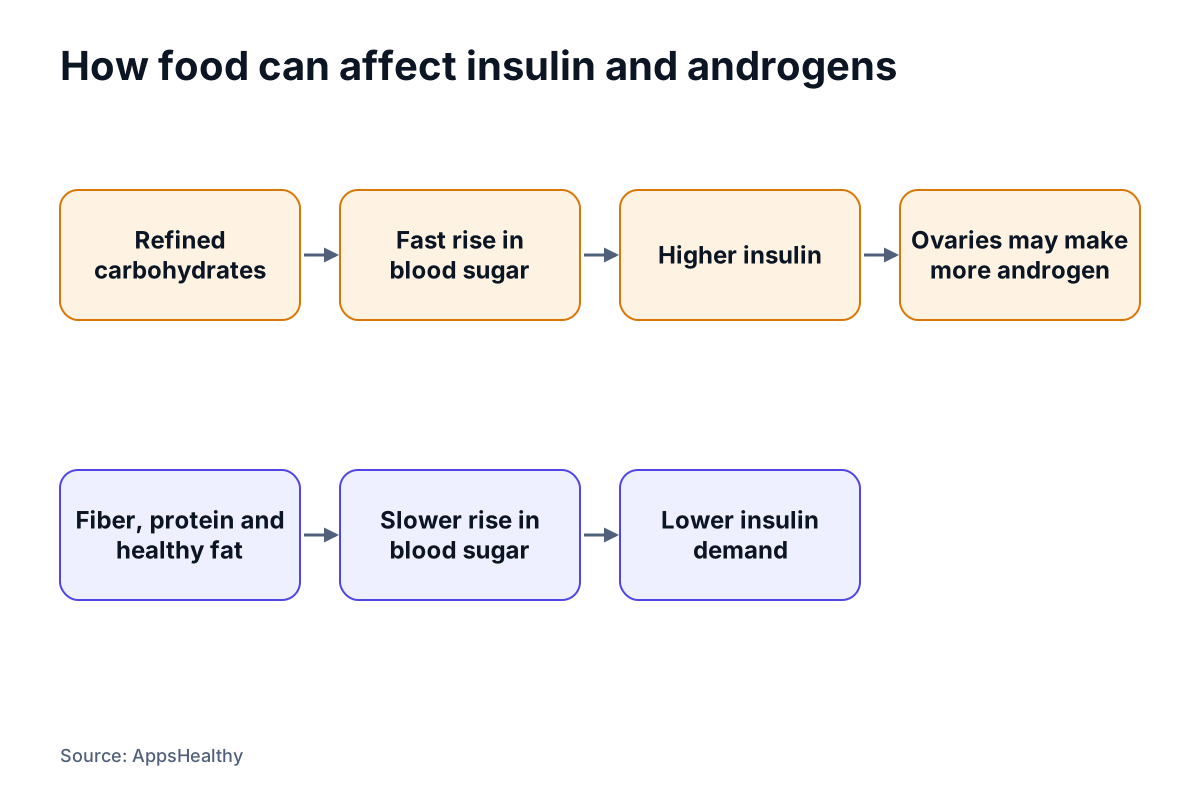
When insulin levels stay high, the ovaries can make more androgens, the male-type hormones such as testosterone. Insulin can also lower sex hormone-binding globulin, a protein that carries testosterone in the blood, so more of the hormone is active. Higher androgen activity can disrupt ovulation and contribute to acne, excess hair growth and scalp hair thinning.
Meals that digest slowly ask less of the insulin system after eating. That is why the quality of carbohydrate matters as much as the quantity for many people with PCOS.
Why weight matters, without blame
Body weight is one factor among many, not a measure of worth. For women with PCOS who have higher weight, the 2023 guideline notes that weight management, including modest weight loss, can be associated with significant clinical improvements. It also recognizes that many women with PCOS experience weight stigma in healthcare, and it supports weight-inclusive care as an option. Any weight goal should never come with shame or pressure.
Many people with PCOS are at a healthy weight, and insulin resistance can still be present in them. Healthy eating matters for those readers too. The article on lean PCOS covers the diagnosis and treatment questions that come up when body weight is typical.
Which eating patterns have the best evidence?
Three eating patterns come up most often in PCOS research: low glycemic index eating, Mediterranean-style eating and lower-carbohydrate approaches. Each has a small body of trials, and the 2023 guideline does not recommend any one of them over the others. The table compares them.
| Eating pattern | Core idea | What the evidence shows | Strength of evidence |
|---|---|---|---|
| Low glycemic index (GI) | Choose carbohydrates that raise blood glucose slowly | Small trials report modest gains in insulin sensitivity and cycle regularity; results vary | Limited |
| Mediterranean-style | Vegetables, legumes, whole grains, fish, olive oil and nuts | Small trials suggest benefits for weight, insulin and metabolic markers | Limited to moderate |
| Lower-carbohydrate or ketogenic | Reduce bread, pasta, sugar and starchy foods | Can improve weight and blood sugar in short studies; long-term safety and adherence data are limited | Limited, short-term |
| Balanced calorie reduction | A modest energy deficit with varied whole foods, when weight is above a healthy range | For people with higher weight, the 2023 guideline links weight management with significant clinical improvements | Moderate |
Low glycemic index eating
The glycemic index (GI) ranks carbohydrate foods by how quickly they raise blood glucose after eating. Oats, lentils, beans, most non-starchy vegetables and whole fruit tend to have a lower GI. White bread, sugary cereals and many packaged snacks tend to have a higher GI.
Trials of low-GI eating in PCOS report modest improvements in insulin sensitivity and cycle regularity, but the studies are small and the results vary. Pairing carbohydrates with protein, fat or fiber at the same meal also slows how fast sugar enters the blood, which makes the approach easier to apply in practice.
Mediterranean-style eating
Mediterranean-style eating centers on vegetables, legumes, whole grains, fish, olive oil and nuts, with modest amounts of dairy and with red meat and sweets kept occasional. In PCOS, several small trials suggest benefits for weight, insulin and other metabolic markers. Because most studies are small and short, the honest description is promising but not proven.
This pattern is also one of the easiest to fit into family meals and cultural cooking, which matters for long-term adherence.
Lower-carbohydrate and ketogenic approaches
Lower-carbohydrate eating reduces the glucose and insulin peaks that follow meals and can produce weight loss in the short term. Ketogenic diets, which are very low in carbohydrate, have been studied in small trials. Long-term safety and whether people can stick with them are not well established, and the 2023 guideline advises avoiding unduly restrictive and nutritionally unbalanced diets.
If you take medicines that lower blood sugar, cutting carbohydrates can change how much medicine you need, so these changes must be planned with your clinician. Do not start a ketogenic diet while pregnant or planning pregnancy without medical advice.
How can you track what works for you?
Diet advice works best when you can see its effect on your own body. Choose one or two changes, keep them for two to four weeks, and then review how your energy, bloating, sleep and cycle look. Write down what changed and what did not.
Give each change time. Many cycles take months to shift, and a short-term change in mood or energy is not the same as a change in ovulation. Bring your notes to your appointment so your clinician can judge what is working.
Try it
Log bloating, energy and mood each day for a few weeks while you change one eating habit, then compare the weekly trends to see what shifted. Open Shebalance
How should a PCOS plate look?
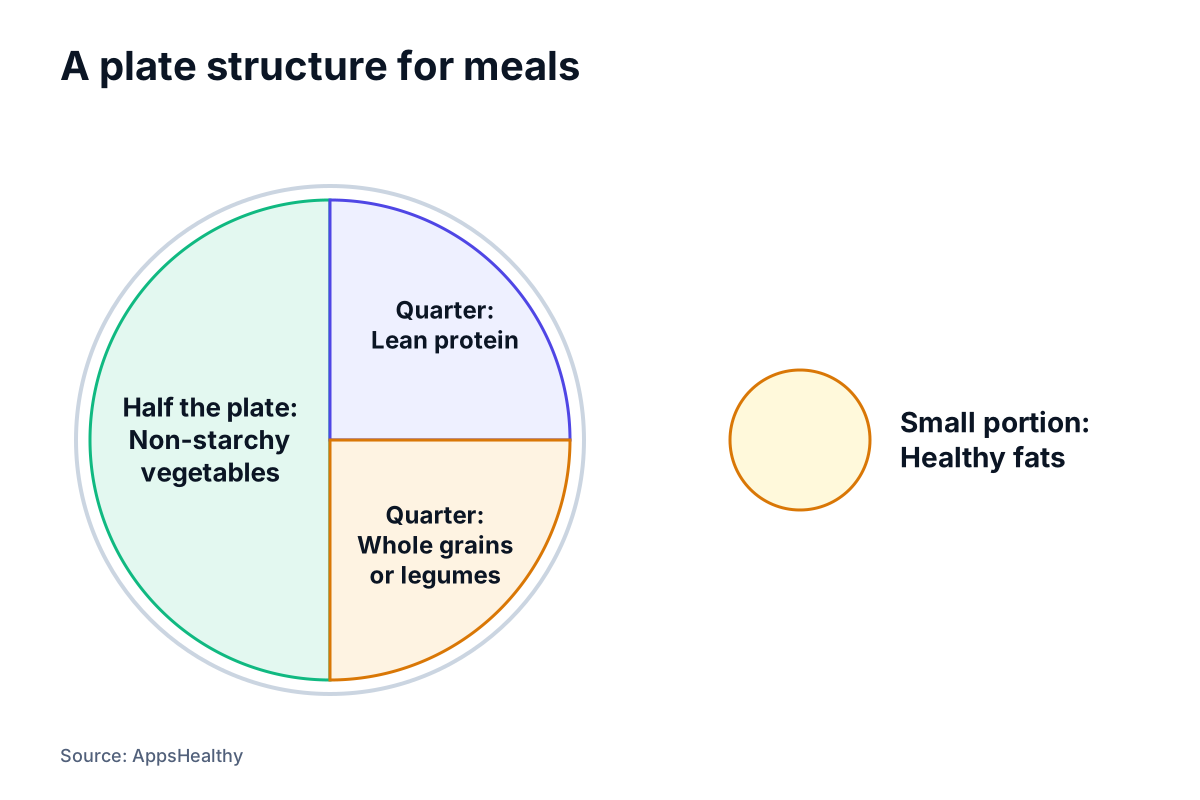
Rigid diet rules are hard to keep, so many dietitians use a plate structure instead. The steps below are a practical starting point for most adults with PCOS. A clinician or registered dietitian can adjust them for medical needs, medicines or pregnancy plans.
- Fill half the plate with non-starchy vegetables such as leafy greens, peppers, broccoli, tomatoes and zucchini.
- Add a palm-sized portion of protein, such as eggs, fish, poultry, tofu, beans or lentils.
- Choose intact carbohydrates such as oats, barley, brown rice, quinoa, whole-grain bread or legumes, instead of white bread or sugary cereal.
- Add a small portion of healthy fat from olive oil, nuts, seeds or avocado.
- Eat fruit whole, and keep sugary drinks rare.
- Keep meals enjoyable by rotating flavors and cuisines, including foods from your own culture.
- Move after eating. A short walk after a meal is a simple habit that many people find helps, and it fits well with the advice in best exercise for PCOS.
Protein at each meal
Protein slows digestion and helps you feel full, which makes the rest of the plate easier to manage. Evidence on protein targets specific to PCOS is limited, so there is no PCOS-specific number to aim for. Animal and plant proteins both fit the approach.
Fiber and whole grains
Fiber slows how quickly sugar enters the blood. In general population studies, higher fiber intake is linked with better insulin sensitivity, but direct trial evidence in PCOS is limited. Whole grains, legumes, vegetables and whole fruit provide fiber along with vitamins and minerals. Increase fiber gradually and drink enough water to avoid bloating.
Are dairy and gluten bad for PCOS?
Dairy and gluten are two of the most searched food questions in PCOS, and both attract strong claims online. Here is what the evidence supports.
Dairy
Evidence on dairy and PCOS is mixed and mostly observational, which means studies link eating patterns with outcomes without proving cause. Associations can differ by product, such as whole-fat versus low-fat dairy, and by how much a person eats. No trial has shown that cutting dairy reverses PCOS.
Dairy also supplies protein, calcium and vitamin D in many diets. If you avoid it because of lactose intolerance or personal choice, replace those nutrients with fortified alternatives, leafy greens, beans or tofu, and mention your choice to your clinician.
Gluten
There is no good evidence that a gluten-free diet treats PCOS in people who do not have celiac disease. Gluten-free packaged foods are often lower in fiber and higher in refined starch, which can make the overall diet worse.
Celiac disease is a separate autoimmune condition, diagnosed with blood tests and sometimes a biopsy. Testing should happen before you cut out gluten, because the tests become unreliable once gluten has been removed. If you do have celiac disease, a gluten-free diet is the treatment, and your clinician will guide it.
Do anti-inflammatory diets and supplements help?
Many women with PCOS have markers of low-grade inflammation in studies, which is one reason anti-inflammatory eating is popular. However, "anti-inflammatory diet" has no single definition, and trials in PCOS are small. The foods usually recommended, such as vegetables, oily fish, legumes, olive oil, nuts and spices, overlap heavily with Mediterranean-style eating, so the practical advice is largely the same.
Supplements are a separate question. Myo-inositol is among the most studied supplements for PCOS, and results vary between trials. For a side-by-side look at inositol and prescribed options, read metformin vs inositol for PCOS. Supplements are not regulated like medicines in every country, can interact with medicines, and are no substitute for treatment. Detox and cleanse plans have no good evidence for PCOS, and some are risky. Ask your clinician before starting any supplement.
What the research says
This section names the sources behind the advice above and says how strong each one is.
- The 2023 International Evidence-based PCOS Guideline is the most recent international guideline for PCOS. It recommends healthy lifestyle behaviours, including healthy eating and physical activity, for all women with PCOS, notes benefits even without weight loss, and links weight management with clinical improvements in women with higher weight. It finds no evidence to support any one type of diet composition over another. Evidence strength: guideline-level for lifestyle as core care; no specific diet is favored.
- The Rotterdam consensus (2004) set the diagnostic criteria for PCOS that the 2023 guideline later refined, and it described the condition's long-term health risks. It is a diagnostic document and does not recommend a particular diet. Evidence strength: consensus-level for diagnosis.
- The 2026 Lancet consensus by Teede and colleagues proposes renaming PCOS as polyendocrine metabolic ovarian syndrome (PMOS), with a three-year transition. The name change does not alter the core food advice, but it places metabolic health at the center of care.
- The CDC's PCOS and diabetes page explains that people with PCOS have a higher risk of type 2 diabetes, which is why blood sugar and eating patterns matter. Evidence strength: well established as a population risk.
- Trials of specific diets in PCOS, including low-GI, Mediterranean-style and lower-carbohydrate eating, are mostly small and short. You can search the primary studies in PubMed and look for systematic reviews in the Cochrane Library. Evidence strength: limited.
Get urgent care if you notice
- Chest pain, pressure, shortness of breath or fainting.
- Heavy bleeding that soaks through a pad or tampon every hour for several hours, or any bleeding after menopause.
- One swollen, painful, warm or red leg, or sudden breathlessness, which can signal a blood clot.
- Severe pelvic or belly pain.
- Dizziness, fainting or confusion after very restrictive eating, or vomiting that does not stop.
- Thoughts of suicide or self-harm. Contact emergency services or a crisis line now.
When to see a doctor
Most healthy eating changes are safe for people with PCOS, but some symptoms need prompt attention. Book a routine appointment if your cycles remain irregular after several months of healthy eating and activity, or if you notice new hair growth, acne or weight changes that worry you. Ask for a referral to a registered dietitian if you are unsure how to build meals for your needs.
Regional notes
United States. The CDC's PCOS and diabetes page, the Office on Women's Health PCOS page and the NICHD PCOS topic page are the main federal sources of patient information. Ask your primary care clinician or an endocrinologist for a referral to a registered dietitian, and check whether your health plan covers it.
United Kingdom. The NHS PCOS page is the starting point for patient advice. A GP can refer you to an NHS dietitian, and the NHS page explains that a healthy, balanced diet and weight management are part of care.
European Union and Australia. National health services and professional societies publish their own PCOS guidance, and the International Guideline 2023 applies alongside it. Check your national health authority or local health service, such as Australia's Department of Health, Disability and Ageing, for referral pathways and dietitian access.
South Asia and the Middle East. Familiar staples such as rice, bread, lentils and sweets can be included in a PCOS-friendly plan by choosing portion sizes, whole-grain versions and fiber-rich combinations rather than eliminating them. Check your national Ministry of Health for local nutrition guidance and community programs.
Frequently asked questions
Is there one best diet for PCOS?
No single diet has been shown to be best for everyone with PCOS. Research supports eating patterns built on vegetables, legumes, whole grains, lean protein and healthy fats, with fewer refined carbohydrates. The best choice is the pattern you can keep up, adjusted to your weight, medicines, culture and preferences with your clinician or a dietitian.
Can changing my diet cure PCOS?
Diet cannot cure PCOS, because the condition involves hormonal and metabolic features that often need ongoing care. Healthy eating can improve blood sugar, weight and cycle regularity for many people, and the 2023 International Evidence-based PCOS Guideline recommends it as part of care. Diet works best alongside any treatment your clinician recommends, and you should not stop prescribed medicines because of a diet change.
Should I avoid dairy if I have PCOS?
Not by default. Evidence on dairy and PCOS is mixed and mostly observational, and no trial has shown that cutting dairy reverses PCOS. Dairy supplies protein, calcium and vitamin D in many diets. If you have lactose intolerance or choose to avoid dairy, replace those nutrients with fortified alternatives, leafy greens, beans or tofu, and discuss bone health with your clinician.
Is a gluten-free diet good for PCOS?
Not unless you have celiac disease or another gluten-related condition. There is no good evidence that gluten-free eating treats PCOS in people without these conditions, and gluten-free processed foods are often lower in fiber. Get celiac testing before you cut gluten, because the tests stop being reliable once gluten is removed.
Does a low-carb diet help PCOS?
Lower-carbohydrate eating can improve blood sugar and weight in short studies, so it may suit some people with PCOS. Long-term safety and adherence are less certain. Very low-carbohydrate or ketogenic diets need medical planning, especially if you take glucose-lowering medicines or are pregnant or planning pregnancy. Choose the level of carbohydrate reduction with your clinician.
Do I need to lose weight to benefit from a PCOS diet?
No. Healthy eating supports blood sugar, cycle regularity and energy whether or not you have overweight or obesity. The 2023 guideline notes benefits of a healthy lifestyle even without weight loss, and links weight management with clinical improvements in women with higher weight. Weight is one factor among many, and any weight goal should be set with a clinician, without shame or pressure.
Are PCOS supplements like inositol worth trying?
Myo-inositol is one of the most studied supplements for PCOS, but results vary between trials and the evidence is not strong enough to replace prescribed treatment. Supplements are not regulated like medicines in every country and can interact with medicines. Talk with your clinician before starting one, and compare the options in the metformin and inositol article.
Should I see a dietitian for PCOS?
Often yes. A registered dietitian can build an eating plan around your symptoms, medicines, budget and food culture, and can help you read labels and plan meals. Ask your clinician for a referral. Many people do best when dietitian support is combined with regular activity, symptom tracking and a clear plan for follow-up.
The bottom line
PCOS diet advice is less about one perfect plan and more about a consistent pattern: vegetables, legumes, whole grains, lean protein and healthy fats, with fewer refined carbohydrates and sugary drinks. The 2023 International Evidence-based PCOS Guideline treats this kind of healthy eating, together with physical activity, as central to care. Dairy and gluten do not need to be removed by default, and supplements or detox plans should never replace treatment. Track how changes affect your symptoms for a few weeks, then bring the record to your clinician. A free, private tracker like Shebalance can make that easier, with no account needed. Get Shebalance on Google Play to start a symptom log today.
Medical disclaimer
This article is for education only and is not medical advice. It does not replace care from a doctor, dietitian or other qualified clinician. Talk with your clinician before making significant diet changes, especially if you take medicines for blood sugar, blood pressure or fertility. AppsHealthy apps do not diagnose or treat PCOS.
References
- World Health Organization. Polycystic ovary syndrome (PCOS), fact sheet. Current version. https://www.who.int/news-room/fact-sheets/detail/polycystic-ovary-syndrome
- Teede HJ, Tay CT, Laven JJE, et al. Recommendations from the 2023 international evidence-based guideline for the assessment and management of polycystic ovary syndrome. Eur J Endocrinol. 2023;189(2):G43-G64 (co-published in Human Reproduction, Fertility and Sterility and The Journal of Clinical Endocrinology & Metabolism). Full guideline: Monash University. https://www.monash.edu/medicine/mchri/pcos/guideline
- Rotterdam ESHRE/ASRM-Sponsored PCOS Consensus Workshop Group. Revised 2003 consensus on diagnostic criteria and long-term health risks related to polycystic ovary syndrome. Human Reproduction. 2004;19(1):41-47. https://doi.org/10.1093/humrep/deh098
- Teede HJ, et al. Polyendocrine metabolic ovarian syndrome, the new name for polycystic ovary syndrome: a multistep global consensus process. The Lancet, 2026. https://doi.org/10.1016/S0140-6736(26)00717-8
- Centers for Disease Control and Prevention. Polycystic ovary syndrome (PCOS) and diabetes. Current version. https://www.cdc.gov/diabetes/risk-factors/pcos-polycystic-ovary-syndrome.html
- NHS. Polycystic ovary syndrome (PCOS). Current version. https://www.nhs.uk/conditions/polycystic-ovary-syndrome-pcos/
- Eunice Kennedy Shriver National Institute of Child Health and Human Development. Polycystic ovary syndrome. Current version. https://www.nichd.nih.gov/health/topics/pcos
- Office on Women's Health, U.S. Department of Health and Human Services. Polycystic ovary syndrome. Current version. https://www.womenshealth.gov/a-z-topics/polycystic-ovary-syndrome
- National Library of Medicine. PubMed database of diet and PCOS trials. https://pubmed.ncbi.nlm.nih.gov/
- Cochrane Library. Systematic reviews of interventions. https://www.cochranelibrary.com/
Shebalance
Track PCOS and menopause symptoms privately: one-tap logs, weekly trends and a doctor-ready PDF. Free, no account.


