Birth Control in Perimenopause: Do You Still Need It?
Birth control in perimenopause is still needed for most women who avoid pregnancy. Compare IUDs, implants and pills in your 40s, and learn when contraception can stop.

On this page
- Do you still need birth control in perimenopause?
- When can you stop birth control after menopause?
- Which birth control methods work best in your 40s?
- Which methods are not a good fit?
- Can birth control help with perimenopause symptoms?
- Is hormone therapy the same as birth control?
- How do you plan and track contraception through perimenopause?
- What about emergency contraception after 40?
- What the research says
- When to see a doctor
- Regional notes
- Frequently asked questions
- The bottom line
Birth control in perimenopause is still needed for most women who want to avoid pregnancy, because irregular periods do not show that ovulation has stopped. Several methods stay effective through the 40s and early 50s. The best choice depends on your age, health history and bleeding pattern, and guidance also explains when birth control can safely stop.
Perimenopause: the transition years before menopause, usually starting in your 40s, when hormone levels rise and fall unevenly and periods become irregular. The Menopause Society defines menopause as 12 months in a row without a period, so you are only in menopause once that point has passed (The Menopause Society).
Key takeaways
- Irregular periods do not prove that you cannot get pregnant, so contraception is still needed for most women who want to avoid pregnancy until menopause is confirmed, according to UK family-planning guidance from the Faculty of Sexual and Reproductive Healthcare (FSRH).
- According to the CDC's "Contraception and Birth Control Methods" page (2024), typical-use failure rates are 0.1–0.4% for the hormonal IUD, 0.8% for the copper IUD, 0.1% for the implant and 7% for the combined pill, patch or ring.
- Under the CDC U.S. Medical Eligibility Criteria (U.S. MEC) 2024, estrogen-containing methods are category 4 (do not use) for migraine with aura and for smokers aged 35 or older who smoke 15 or more cigarettes a day.
- Fertility usually returns quickly after stopping the pill, patch, ring, IUD or implant, while the DMPA injection can delay return of fertility for several months after the last shot.
- Menopausal hormone therapy (HRT) eases symptoms but does not prevent pregnancy, according to FSRH guidance, so women who still need contraception use a separate method, such as a 52 mg hormonal IUD that can also protect the uterine lining during HRT.
- FSRH guidance (2017, amended 2023) says women on non-hormonal methods can stop after 2 years without a period if they are under 50, or after 1 year if they are 50 or older, and that most women can stop all contraception at 55.
- IUDs have labeled durations, but FSRH guidance supports keeping a 52 mg hormonal IUD placed at 45 or older for contraception until 55, and a copper IUD placed at 40 or older until menopause.
Do you still need birth control in perimenopause?
Perimenopause is not a form of contraception. Hormone levels swing from month to month, so an egg can still be released in a cycle with a late, short or skipped period. The World Health Organization's menopause fact sheet places natural menopause generally between ages 45 and 55, which means many women remain able to conceive for years before they reach that point (WHO menopause fact sheet).
Many women are surprised by this, especially when periods have become unpredictable. The FSRH guidance on contraception for women over 40 treats pregnancy as a real possibility during perimenopause, and asks clinicians to keep contraception going until a woman can be confident she has reached menopause. For readers, the practical message is simple: if you want to avoid pregnancy, do not stop your method because your periods look different. For the full list of changes to expect, see our perimenopause symptoms guide.
Can you still get pregnant in your 40s?
Yes. A woman in her 40s can ovulate, and an unplanned pregnancy can happen even when cycles are long or irregular. Pregnancy at this age is also more likely to be classed as high-risk than pregnancy earlier in life, so many clinicians treat reliable contraception as part of planned care. The ACOG patient FAQs are a good starting point for questions about pregnancy and birth control in midlife.
Do irregular periods mean birth control is no longer needed?
No. Irregular bleeding is one of the defining features of perimenopause, but it does not tell you whether ovulation is still happening. Only a clear time without a period, combined with your age and your clinician's advice, shows when contraception can be reconsidered. Do not rely on a single blood test or on a gap in bleeding alone.
When can you stop birth control after menopause?
The stop date is not a single birthday. It depends on your age, how long you have gone without a period and whether a hormonal method has been hiding your normal bleeding pattern. The FSRH guideline "Contraception for Women Aged over 40 Years" (2017, amended 2023) sets out these age-based rules:
- Non-hormonal methods (copper IUD, condoms): stop after 2 years without a period if you are under 50, or after 1 year without a period if you are 50 or older.
- Combined pill, patch or ring, and the DMPA injection: can usually continue until 50, then switch to a non-estrogen or non-hormonal method.
- Progestogen-only pill, implant or hormonal IUD: can continue to 55. If you are over 50 and have no periods, an FSH (follicle-stimulating hormone) blood test can help decide whether to stop earlier.
- Age 55: most women can stop all contraception, because natural pregnancy after this age is very rare.
Hormonal methods can hide your natural bleeding pattern, so a lack of periods on them does not show that you have reached menopause. Use the steps below to prepare for the conversation with your clinician.
- Record the date of your last period, and every bleed or spot since then, in a calendar or a symptom log.
- Note whether your current method, such as the pill, a hormonal IUD or an implant, changes or hides your bleeding. Hormonal methods can mask the normal pattern, so a quiet period on them tells you less.
- Write down your age and any health factors, such as smoking, high blood pressure or a history of blood clots, because they affect both the method and the timing.
- Ask your clinician which FSRH age-based rule applies to you, and whether a blood test would add anything. FSH testing is only useful in some situations, such as women over 50 using a progestogen-only pill, implant or hormonal IUD. It gives misleading results on combined methods or HRT, so symptoms and bleeding history usually carry more weight.
- Agree on a stop date, or on a review date, and keep a method in place until you have that conversation.
Once you have worked through the steps, the decision path below shows the usual logic. It is a guide for talking to your clinician, not a replacement for their advice. A planner such as Cerca can keep these dates together.

Which birth control methods work best in your 40s?
Most methods that suit healthy women in their 20s and 30s remain options in perimenopause. What changes is the health check and the expected bleeding pattern. The CDC's typical-use figures, which reflect how methods perform with real-life use, show a wide spread between the most and least effective choices. Cerca's methods library lists 12 methods with these CDC figures, how to start and missed-dose steps. For the wider decision, read How to choose the right birth control.
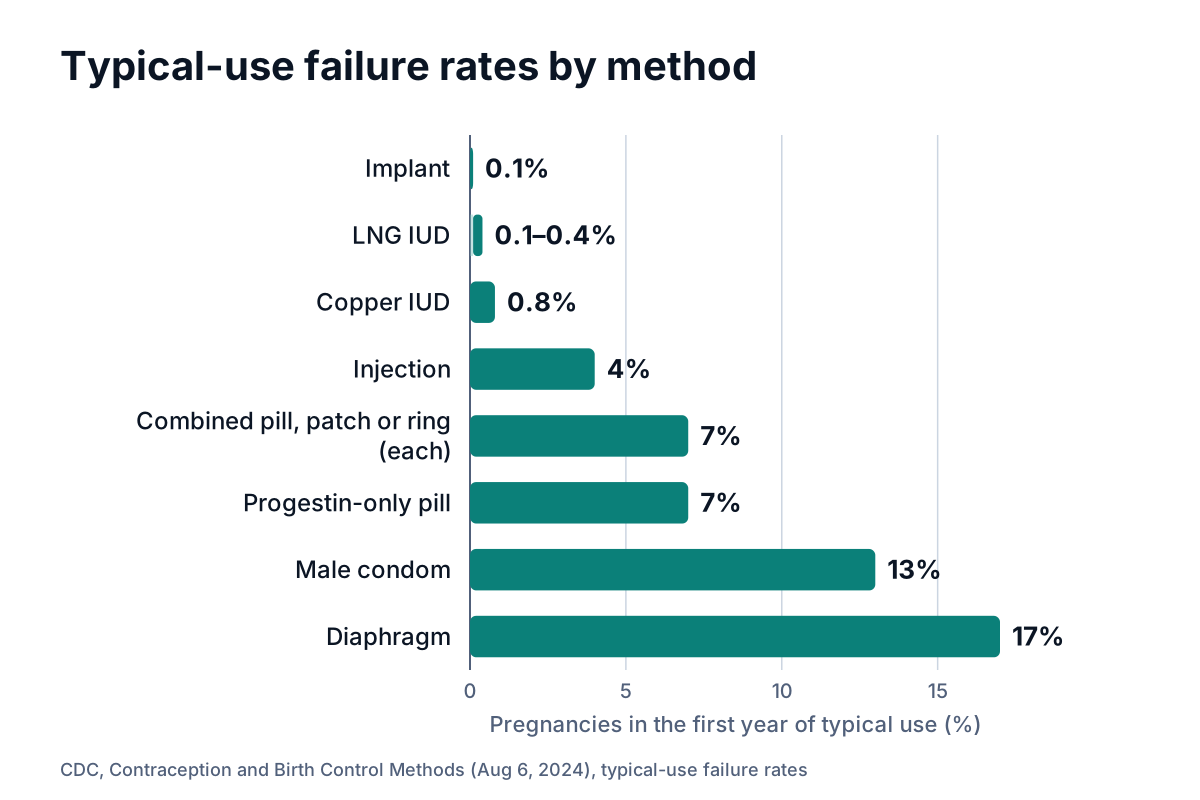
The table below sets out the main options for women in their 40s, with the CDC typical-use figure for each and the points that matter most in perimenopause.
| Method | Typical-use failure (CDC 2024) | Points to know in perimenopause |
|---|---|---|
| Hormonal IUD (levonorgestrel 52 mg) | 0.1–0.4% | Labeled for up to 8 years (Mirena, Liletta); often lightens periods |
| Copper IUD | 0.8% | Non-hormonal; labeled for 10 years (Paragard); can make periods heavier |
| Implant | 0.1% | Labeled for 5 years in the US; bleeding changes are common |
| Injection (DMPA) | 4% | Fertility can take several months to return after the last shot |
| Combined pill, patch or ring | 7% each | Contains estrogen; needs a health check first |
| Progestin-only pill | 7% | Includes the over-the-counter daily pill Opill in the US |
| Tubal surgery (sterilization) | 0.5% | Permanent; decide carefully |
| Vasectomy | 0.15% | A permanent option for a partner |
Hormonal IUDs
A hormonal IUD releases a small amount of levonorgestrel into the uterus and is one of the most effective reversible methods available. Mirena is FDA-approved to treat heavy menstrual bleeding (for up to 5 years) in women who choose an IUD for contraception, and many women find their periods become lighter or stop altogether. Each brand has its own labeled duration, but FSRH guidance supports keeping a 52 mg hormonal IUD placed at 45 or older for contraception until 55. A hormonal IUD can also serve as the progestogen part of HRT: in the UK, Mirena is licensed to protect the lining of the uterus during estrogen therapy for 4 years, and FSRH guidance supports using it for up to 5 years in that role. Ask your clinician when your device should be changed.
Copper IUD
The copper IUD contains no hormones and works for up to 10 years, according to its FDA labeling. Its typical-use failure rate is 0.8% in the CDC figures. Copper IUDs can make periods heavier or more crampy, especially in the first few months, so women with heavy bleeding often prefer a hormonal option. The copper IUD is also the most effective form of emergency contraception when inserted within 5 days of unprotected sex, as listed in the CDC's U.S. Selected Practice Recommendations (U.S. SPR) 2024.
Implant
The contraceptive implant is a small rod placed under the skin of the upper arm. Nexplanon is FDA-approved for 5 years of use in the US, and its typical-use failure rate is 0.1% in CDC figures. Irregular bleeding is the most common side effect, and it can make bleeding patterns harder to read in perimenopause, which is one reason to keep a symptom log.
Combined pill, patch and ring
Combined methods contain both estrogen and progestin, and they give a typical-use failure rate of 7% in the CDC figures. They can make cycles more regular and predictable, which some women value during perimenopause. They are not suitable for everyone, however. Both the CDC U.S. MEC 2024 and the UK Medical Eligibility Criteria (UKMEC) 2025 rate combined methods category 2 from age 40, meaning the benefits generally outweigh the risks, and FSRH guidance advises switching to another method at 50. Your clinician will check blood pressure, smoking status, migraine history and clot risk before recommending them. The CDC's U.S. MEC 2024 sets out the categories used by clinicians.
Progestin-only pill and injection
Progestin-only pills contain no estrogen and suit many women who cannot take estrogen-containing methods. The typical-use failure rate for the progestin-only pill is 7%. The DMPA injection, given every few months, has a typical-use failure rate of 4%, and it is the only method where fertility can take several months to return after the last shot. Over age 45, DMPA moves to category 2 in both the UKMEC 2025 and the U.S. MEC 2024, partly because of its effect on bone density, and FSRH guidance suggests switching methods at 50. That delay matters if you plan to stop contraception in order to try for a pregnancy.
Which methods are not a good fit?
Some health factors change which methods are safe, and they matter more in midlife than in younger years. The CDC's U.S. MEC 2024 is the reference clinicians use to check them, and it groups each method for each condition into categories from 1 (use without restriction) to 4 (do not use).
Smoking and migraine with aura
Under the U.S. MEC 2024, estrogen-containing methods are category 4 for women with migraine with aura. They are also category 4 for smokers aged 35 or older who smoke 15 or more cigarettes a day, and category 3 (usually not recommended) for those who smoke fewer. If you smoke, stopping is one of the most useful steps you can take before choosing a method, and your clinician can suggest a plan for that.
Breast cancer and blood clot history
Under the U.S. MEC 2024, current breast cancer is category 4 for all hormonal methods. A history of blood clots, or a family history of clotting disorders, also changes the choice. The CDC MEC explains how these conditions are scored. For a detailed look at clot and cancer risks, read our guide on birth control blood clots and breast cancer risk.
Other conditions your clinician will check
Your clinician will also review blood pressure, diabetes, liver disease and any medicines you take, since some drugs reduce the effect of hormonal methods. Bring a full list of medicines and supplements to your visit. Do not stop or change any prescribed medicine without talking to your clinician first.
Can birth control help with perimenopause symptoms?
Birth control is not a treatment for menopause symptoms, but some methods can make bleeding more predictable and reduce the disruption that heavy or irregular periods cause. Evidence for other symptoms, such as hot flashes and mood, is more limited, and it is best to discuss expectations before starting.
Heavy or irregular bleeding
Heavy or irregular bleeding is one of the most common reasons women in perimenopause seek help. A hormonal IUD or a combined pill can reduce blood loss and make cycles more regular. The copper IUD does not offer this benefit and may increase bleeding, so it is a poor fit for some women with heavy periods. Your clinician can help you decide between these options, and an urgent review is needed if bleeding is very heavy or you feel faint.
Hot flashes, sleep and mood
Some women report fewer hot flashes or better sleep on combined hormonal methods, but the research on this is limited and not consistent. Clinical trials of birth control have mostly measured pregnancy prevention and bleeding rather than menopause symptoms. Hot flashes and mood changes need their own treatment plan, and our guide on menopause and sleep covers night sweats in detail.
Try it
Two or three cycles of notes on bleeding and symptoms give your clinician a clearer picture of whether a method is helping. The free Cerca web app lets you track cycles privately and set reminders. Its cycle predictions are not contraception, so keep using your method.
Is hormone therapy the same as birth control?
No. Menopausal hormone therapy (HRT) is designed to relieve symptoms such as hot flashes and vaginal dryness, and it is not a reliable method of preventing pregnancy. Its doses and purpose differ from those of contraceptives, so a woman who still needs contraception should not assume that HRT covers her. For a full look at HRT safety and recent label changes, read our article on whether HRT is safe now.
Can HRT be used as birth control?
No. Hormone therapy is not designed or labeled to prevent pregnancy, and FSRH guidance states that HRT does not provide contraception, so do not assume that symptom relief means you are protected. Many women use HRT together with a contraceptive method during perimenopause. A 52 mg hormonal IUD, such as Mirena, can do both jobs: it prevents pregnancy and acts as the progestogen part of HRT alongside estrogen. Progestogen-only pills and implants can also be used for contraception alongside HRT, but they do not protect the uterine lining on their own.
Why the two decisions are separate
Choosing HRT is about symptom relief and long-term health, while choosing contraception is about preventing pregnancy. The Menopause Society's 2022 position statement on hormone therapy, for example, weighs the benefits and risks of HRT for symptoms, while contraception is a separate decision. Treat the two as separate conversations, even if they happen at the same appointment.
How do you plan and track contraception through perimenopause?
Good planning in perimenopause has two parts: a method that fits your health, and a record of what your body is doing. A simple log makes both easier to discuss with your clinician, and it helps you notice when a method needs to change.
Track bleeding and symptoms
Note the date and length of each bleed, spotting between periods, and any hot flashes, sleep changes or mood shifts. A symptom tracker such as Shebalance lets you log severity in one tap and shows weekly and monthly trends, so you can see what is improving or worsening. Its doctor-ready PDF report is useful for appointments about contraception and menopause.
Plan your method and timing
A five-year plan helps when your needs change over time, for example from avoiding pregnancy now to preparing for menopause later. Cerca includes a five-year roadmap built from your family plans and health history, checked against WHO and CDC guidance, and it can be re-planned as your situation changes. Use it alongside your clinician's advice, not in place of it.

Cerca also has a methods library covering 12 methods, with CDC typical-use effectiveness, how to start, missed-dose steps and warning signs. Use it to compare options before your appointment, and to check the steps that apply to the method you choose.
What about emergency contraception after 40?
Emergency contraception is still available to women in their 40s, and it is worth knowing the options before you need them. The levonorgestrel pill (Plan B One-Step and generics) is labeled for use within 72 hours of unprotected sex, works best the sooner it is taken, and is sold over the counter in the US with no age limit. It may be less effective at higher body weight. Ulipristal acetate (ella) works for up to 120 hours, requires a prescription in the US, and hormonal contraception should not be started until 5 days after taking it, according to the CDC's U.S. SPR 2024. The copper IUD, inserted within 5 days, is the most effective option. For timing and steps, see our guide to emergency contraception.
What the research says
Most of the strongest evidence on birth control effectiveness comes from the CDC's summary of methods and from James Trussell's reviews of U.S. contraceptive failure data. The CDC's typical-use figures, which include the mistakes and missed doses of everyday life, show a wide gap between methods. The perfect-use figures, which assume every instruction is followed, are lower: according to Trussell's 2011 analysis in Contraception, the pill, patch and ring fail in about 0.3% of perfect-use years, the copper IUD in 0.6%, the LNG IUD in 0.2% and the implant in 0.05%. The gap between perfect and typical use shows how much real-life support matters for methods that depend on daily action.
The CDC's U.S. MEC 2024 and U.S. SPR 2024 are the main US references for choosing and using methods with health conditions. The WHO's Medical Eligibility Criteria, sixth edition (2025), is the global equivalent, and it uses similar categories. For women in perimenopause, these documents give the most detailed guidance on who should avoid estrogen and when a method needs extra checks.
Evidence for the non-contraceptive effects of birth control in perimenopause is more limited. Studies have mostly looked at bleeding patterns and pregnancy prevention, with less data on hot flashes and mood. The Menopause Society's 2022 hormone therapy position statement is useful background, because it discusses when hormone therapy is appropriate, but it does not replace a contraception plan. The evidence on the age-based stop rule rests on expert guidance, not on large trials, and that is why clinicians review it case by case.
When to see a doctor
Most changes in bleeding during perimenopause are part of the transition, but some signs need prompt medical review. Seek care quickly if you notice any of the following.
Get urgent care if you notice
- Bleeding after you have reached menopause (12 months without a period), or any new bleeding while you are on a hormonal method that you cannot explain.
- Heavy bleeding that soaks through protection every hour, bleeding with dizziness or fainting, or bleeding that lasts much longer than usual.
- Possible pregnancy with severe pelvic or shoulder-tip pain, fainting or heavy bleeding.
- Calf pain or swelling, sudden chest pain or sudden shortness of breath, which can be signs of a blood clot.
- Sudden weakness or numbness on one side, trouble speaking, or a sudden severe headache, which need emergency care.
- Thoughts of suicide or self-harm. Call your local emergency number or a crisis line straight away.
Regional notes
United States (FDA, CDC, ACOG): The CDC's U.S. MEC 2024 and U.S. SPR 2024 guide clinicians on which methods suit which health conditions. The FDA approved Opill, a progestin-only daily pill, in July 2023 as the first over-the-counter daily birth control pill, and levonorgestrel emergency contraception is sold over the counter with no age limit. ACOG's patient FAQs cover questions about birth control at different ages.
United Kingdom (NHS, NICE, FSRH): The NHS contraception pages describe the main methods and how to get them, and the NHS menopause page explains symptoms and treatment options. The FSRH guideline "Contraception for Women Aged over 40 Years" (2017, amended 2023) is the main UK reference for the age-based stop rules, and it is worth asking your GP or sexual health clinic to review it with you.
European Union and Australia: Access to hormonal methods, IUD fitting and emergency contraception varies by country and by prescription rules. In Australia, the Therapeutic Goods Administration regulates medicines, and your general practitioner or sexual health service can explain what is available locally.
South Asia and the Middle East: Availability and cost of methods vary widely, and in many places a clinic visit is needed for an IUD or implant. The WHO's family planning fact sheet sets out global guidance on contraceptive options, and a local family-planning clinic or women's health service can advise on what is practical where you live.
Frequently asked questions
Can you get pregnant during perimenopause?
Yes. Perimenopause is the transition before menopause, and ovulation can still happen even when cycles are irregular, long or skipped. Pregnancy remains possible until menopause is confirmed, which means 12 months in a row without a period. If you want to avoid pregnancy, keep using a reliable method and talk to your clinician before changing it.
Is a copper IUD a good option in my 40s?
It can be, especially if you want a method without hormones that works for up to 10 years. The copper IUD has a typical-use failure rate of 0.8% in CDC figures. It may make periods heavier or more painful, so women with heavy bleeding often prefer a hormonal IUD. Your clinician can help weigh bleeding, cramping and health factors when you compare the two.
Can I stay on the combined pill until menopause?
Many women can, but the decision depends on your health. Smoking, migraine with aura, high blood pressure and a history of blood clots all change the advice, and the CDC's U.S. MEC 2024 sets out the categories clinicians use. Your clinician will check these factors before recommending a combined pill, patch or ring, and will review the plan regularly.
When can I stop birth control after menopause?
Stopping depends on your age, your method and how long you have gone without a period. FSRH guidance says non-hormonal users can stop after 2 years without a period if under 50, or 1 year if 50 or older, and most women can stop at 55. Hormonal methods can hide periods, so these rules differ for them. Keep your method until you have agreed a stop date with your clinician, and report any bleeding that returns after you stop.
Does a hormonal IUD stop periods?
For many women, a hormonal IUD makes periods lighter, and some stop having periods altogether. This is common because the levonorgestrel in the device thins the lining of the uterus. Periods can still return in some women, and bleeding that changes after several months should be reviewed. The IUD is also labeled for a set number of years, so ask when yours should be checked.
Can I use HRT as birth control?
No. Menopausal hormone therapy is designed to relieve symptoms, not to prevent pregnancy, and FSRH guidance states that it does not provide contraception. If you still need protection from pregnancy, keep using a contraceptive method alongside HRT. A 52 mg hormonal IUD can provide contraception and also protect the uterine lining during HRT, so ask your clinician whether it suits you.
Is emergency contraception still available after 40?
Yes. The levonorgestrel pill is sold over the counter in the US with no age limit, and it is labeled for use within 72 hours. Ulipristal acetate works for up to 120 hours but requires a prescription in the US. The copper IUD, inserted within 5 days, is the most effective emergency option. If you are unsure which to use, contact a pharmacist or clinic as soon as possible.
The bottom line
Birth control in perimenopause is still needed for most women who want to avoid pregnancy, because irregular periods do not show that ovulation has stopped. Choose a method by weighing its effectiveness, its effect on bleeding and your health factors, such as smoking, migraine with aura and clot history. Do not stop on the basis of irregular periods alone. Track your bleeding, ask your clinician whether the FSRH age-based rule applies to you, and agree a stop date together. Seek urgent care for bleeding after menopause or any sign of a blood clot. To prepare for those conversations, the free Cerca web app can help you plan privately, and Shebalance on Google Play can log symptoms for your next appointment.
Medical disclaimer
This article is for education only and is not medical advice. It does not replace the care of a qualified clinician. Contraception choices, stopping dates and treatments depend on your personal health history, so talk to your doctor, nurse or sexual health clinician before you start, change or stop any method. Apps described here do not diagnose, treat or prevent pregnancy.
References
- Centers for Disease Control and Prevention. Contraception and Birth Control Methods. Updated August 6, 2024. https://www.cdc.gov/contraception/about/index.html
- Centers for Disease Control and Prevention. U.S. Medical Eligibility Criteria for Contraceptive Use, 2024. https://www.cdc.gov/contraception/hcp/usmec/index.html
- Centers for Disease Control and Prevention. U.S. Selected Practice Recommendations for Contraceptive Use, 2024. https://www.cdc.gov/contraception/hcp/usspr/index.html
- Trussell J. Contraceptive failure in the United States. Contraception. 2011;83(5):397-404. https://doi.org/10.1016/j.contraception.2011.01.021
- Faculty of Sexual and Reproductive Healthcare (FSRH). FSRH Guideline: Contraception for Women Aged over 40 Years. August 2017, amended July 2023. https://www.fsrh.org/ [VERIFY LINK]
- World Health Organization. Medical eligibility criteria for contraceptive use, 6th edition. 2025. https://www.who.int/publications/i/item/9789240115583
- World Health Organization. Menopause fact sheet. https://www.who.int/news-room/fact-sheets/detail/menopause
- The North American Menopause Society (now The Menopause Society) Advisory Panel. The 2022 hormone therapy position statement of The North American Menopause Society. Menopause. 2022;29(7):767-794. https://doi.org/10.1097/GME.0000000000002028
- College of Sexual and Reproductive Healthcare (CoSRH, formerly FSRH). UK Medical Eligibility Criteria for Contraceptive Use (UKMEC). 2025. https://www.fsrh.org/ [VERIFY LINK]
- Bayer plc. Mirena 20 micrograms/24 hours intrauterine delivery system: Summary of Product Characteristics. electronic medicines compendium. https://www.medicines.org.uk/emc/product/1132/smpc
- NHS. Menopause. https://www.nhs.uk/conditions/menopause/
- NHS. Contraception. https://www.nhs.uk/contraception/
- American College of Obstetricians and Gynecologists. Patient FAQs. https://www.acog.org/womens-health/faqs
- U.S. Food and Drug Administration. Product labeling for levonorgestrel intrauterine systems and Opill. https://www.fda.gov/ [VERIFY LINK]
Shebalance
Track PCOS and menopause symptoms privately: one-tap logs, weekly trends and a doctor-ready PDF. Free, no account.
Cerca
Plan contraception with WHO and CDC-checked guidance: compare 12 methods and build a 5-year plan. Free to use, no email needed.


